
Harold and the Moon
Harold and the Purple CrayonHarold's relationship with the Moon develops from a need for moonlight into companionship and, finally, a means of finding the bedroom window.
increasing Bearing strength in each event
 decreasing
Bearing strength in each eventdecreasingA Needed Presence

Wanting the Moon
A missing companion
Harold wants a moonlight walk, but there is no Moon. Its absence matters because it frustrates the kind of evening he has chosen, not because Harold has lost an established companion.
Making the desired night
He draws a Moon and sets off. The act turns his wish into a shared scene in which the Moon can accompany him through the journey.
The Moon Goes Along

Company on the Move
A responsive sky
As Harold leaves the straight path for a shortcut, the Moon goes with him. It follows the motion of the adventure rather than remaining a remote object in a fixed sky.
Presence through uncertainty
The Moon's company does not eliminate the forest, the ocean, or Harold's later confusion. Its significance is relational: it remains beside him even when the route itself changes.
Companionship Becomes Guidance
The Companion's Meaning
A remembered connection
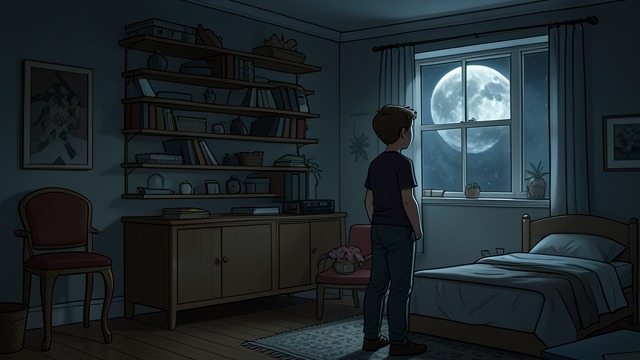
Harold recalls that his bedroom window is always around the Moon. The Moon's role deepens from something he wanted for the outing into a point of reference tied to his room.
A way to rest
That recognition lets Harold make his bed and settle down. The remembered relationship between Moon and window helps transform a long, disorienting walk into a return to safety.
At the opening, before the walk begins
Early in the journey, when Harold crosses a field
Near the ending, as Harold walks back toward home
